


A while back, I worked with a string of coaches to help me figure out what was next for me professionally.
My career spanned multiple sectors, fields, and roles, all under the vast umbrella of urban development. My problem, I thought, was that I had too many varied interests and skills; I needed to finally buckle down and figure out what my next “perfect” job should be.
I analyzed so many different possible roles, from non-profit exec to private development lead. I made pro and con lists to help me decide which ones to explore and which to let go. Yet, I still couldn’t figure it out. I was lost and frustrated.
So one day, sitting in my sunlit home office, a coach tried something different. He asked me to close my eyes and clear my mind. Then he asked me to fill the blank slate with a vision for myself.
I could not conjure a single detail. Only an empty abyss staring back at me.
Here’s the irony. I had spent my entire career helping others create visions for their communities. I should be able to do this for myself, right?!
That experience shook me. Not in a bad way. In a necessary way. I could finally see that the word “should” obscured my vision. It “should” be within urban development, it “should” be another rung up the ladder, it “should” be an impactful role, it “should” pay me my worth.
That list of "shoulds" had become a wall. I'd been standing in front of it so long, I stopped noticing it was there.
This is exactly the opposite of what I told community members in neighborhood visioning sessions. I would say, this is the time to dream big, remove constraints. We’ll deal with those once we know where we’re headed.
So I had to practice what I preached. I put down those expectations and painted that blank slate from within. I finally envisioned my future self. I’ve followed her lead ever since.
How? By moving from optimizing to designing.
1. Start with Wonder
When it comes to planning for our own lives, we often ask, “What should I do?” When it comes to a vision for a neighborhood, we ask, “What could this place be?”
Should is expectation-based. It’s limiting.
Could is possibility-based. It’s expansive.
Too often, though, there’s noise blocking our ability to see a vision for ourselves. Pressures at work. Pressures at home. Expectations and beliefs—true or not—that stack up and obscure our line of sight. To open that imagination again, you have to get curious about what makes you, well—you.
I want you to look for your “memory orbs”—think Inside Out, but yours. Think of the small, charged moments that seem minor on the surface but leave you feeling alive. Stay with me, because we're going to build something real with them.
The human brain encodes and stores emotionally charged memories. If you let scenes surface, I bet you’ll find small, “insignificant” moments that light you up. What were you doing? Helping others? Crafting something with your hands? Problem-solving? Getting lost in nature? Take note of them without filtering. You're not looking for a theme yet, just sparks.
These are your clues. They are the sources of wonder that Bill Burnett and Dave Evans, the co-founders of the Stanford Life Design Lab, say are essential to design. Imagination starts in reality. To be a good designer, you have to approach the world with a sense of wonder and make yourself available to what it has to offer. As they remind their students: “wonder only arrives in small chunks.”
We need to make space for wonder. But we’ve gotten very good at doing the opposite. We’ve even tried to turn wonder into a formula. Take the Ikigai Venn diagram. It’s often used in career guidance settings to help people find the “perfect” overlap of what you love, what you’re good at, what the world needs, and what you can get paid for.
It turns wonder into an optimization exercise. And if you can’t find that perfect overlap, you feel lost. But the original Japanese concept is much more grounded in design-thinking, in wonder. Professor Akihiro Hasegawa, a leading researcher on the topic, describes ikigai as the feeling that one is alive in the here and now. It’s about personal agency and a focus on daily wonder, not an optimized diagram.
Step one. Follow the wonder.
But wonder alone isn’t enough.
Many people get stuck here: they can sense what energizes them and still not know what to do with it.
That’s where design comes in.
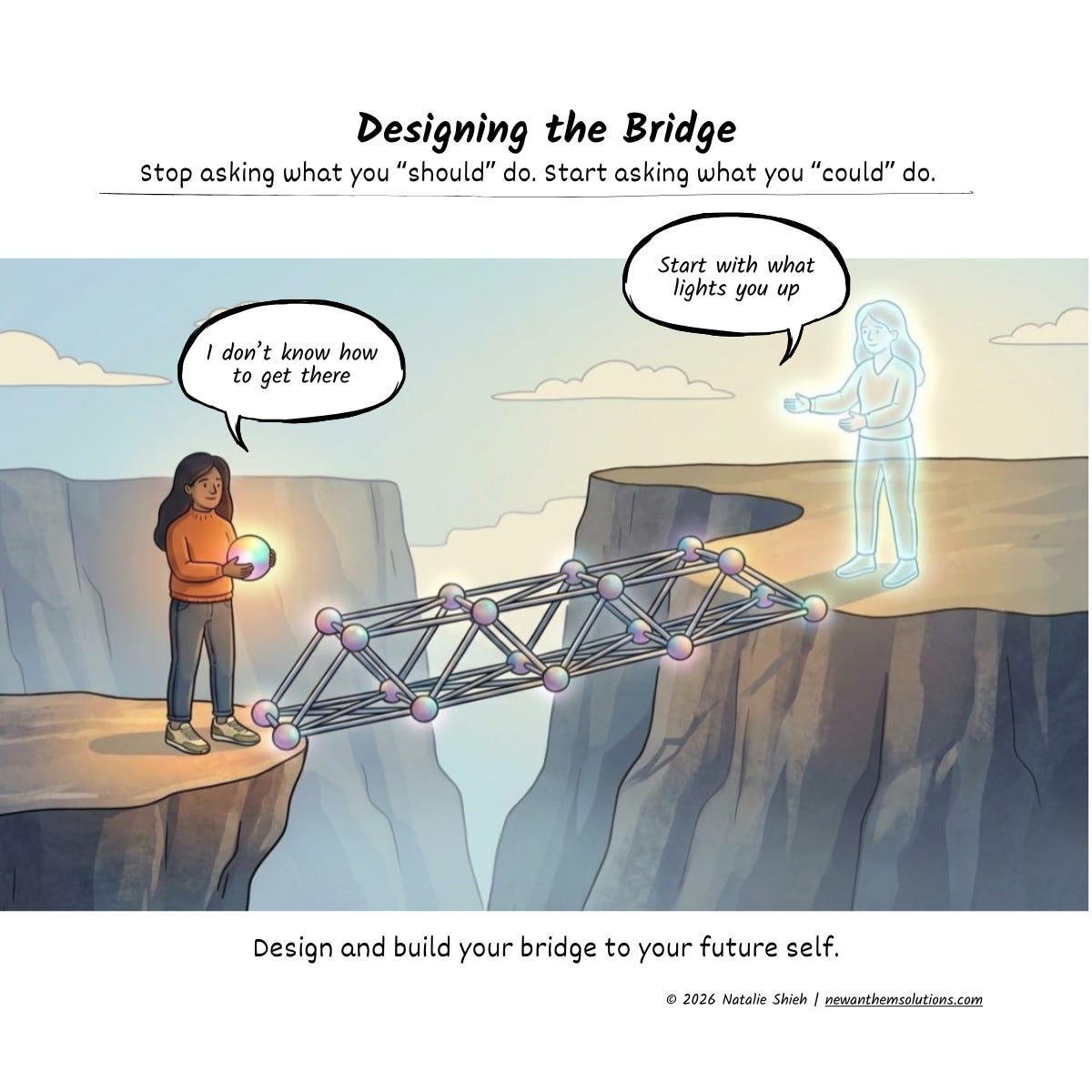
2. Design the Bridge: From “Should” to “Could”
This is where you start working with those memory orbs.
Wonder got you here. Now it’s about experimentation and learning.
Picture your orbs as raw material — the things that already energize you — and the bridge as the structure you build from them toward your Future Self. You’re not standing on one side of a canyon looking at a distant Future-Self. You are using what energizes you to build the path toward yourself. Each plank is a small action, an experiment, a next obvious step. NOT a grand plan.
Visualization is a powerful tool here. It is more than wishful thinking; it’s a form of mental rehearsal.
My own curiosity led me to the research, and there’s more behind this than I expected. It shows that when you vividly imagine something, your brain activates many of the same neural pathways as if you were physically doing it.1 In one Harvard study, people who simply imagined practicing a skill showed measurable changes in the brain’s motor cortex.2
And this effect is amplified when the vision is about you.
When you imagine your Future Self, your brain isn’t just daydreaming—it’s activating the same systems it uses to make decisions in real life.3 Visualization helps you rehearse the actions and decisions needed to make it real. It’s a virtual experiment of what you “could” do, free of charge in your own mind.
By visualizing the bridge, you are essentially priming your brain to recognize the “Next Obvious Step.” You are training yourself to notice the opportunities that the version of yourself that is weighed down by “should” would have missed entirely.
You become what you believe you can do.
And you prove it through what you practice.
We’ll build on this next.
Caspers, S., et al. (2010). “The Human Action-Observation Network: A Meta-Analysis.” NeuroImage.
Pascual-Leone, A., et al. (1995). “Modulation of muscle responses during the acquisition of new fine motor skills.” Journal of Neurophysiology.
D’Argembeau, A., et al. (2010). “The Role of the Ventromedial Prefrontal Cortex in Self-Referential Processing: Evidence from Episodic Future Thinking.” Journal of Cognitive Neuroscience.